
Follow our social channels for the latest property market updates, insights and opportunities.
The Reserve Bank Hits Pause – For Now
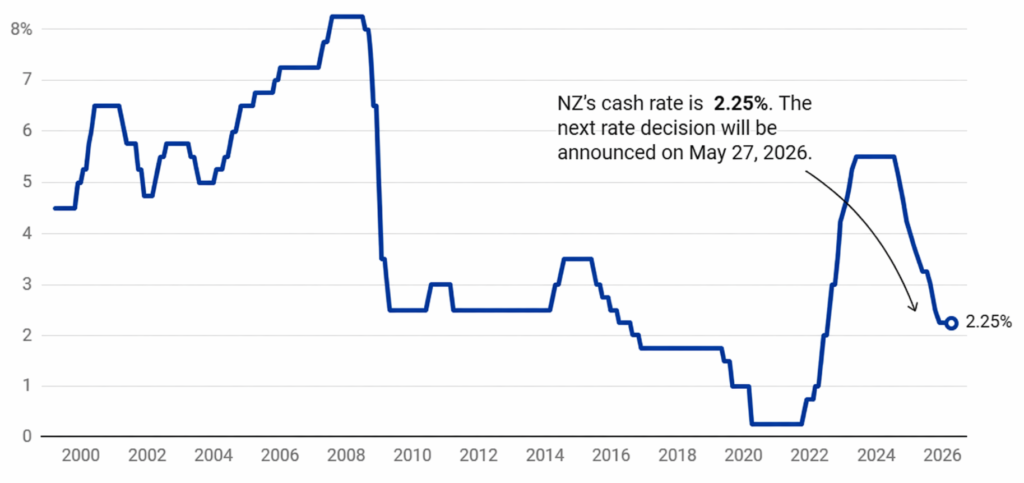
The Reserve Bank of New Zealand’s (RBNZ) decision to hold the Official Cash Rate at 2.25% on 8 April 2026 was widely expected, but it still sends an important signal to the market.
At its core, the decision reflects a balancing act. Inflation risks remain, but New Zealand’s economic recovery is still fragile. Rather than move too quickly and risk slowing the economy further, the Reserve Bank has chosen to hold steady while keeping a close eye on what happens next.
For buyers, that means the environment remains relatively supportive in the short term, even if the tone from RBNZ suggests it is staying alert to any renewed inflation pressure.
Source: OneRoof.co.nz, Reserve Bank of New Zealand
Why The War Matters to the New Zealand Economy
While the conflict in the Middle East feels far away, its impact reaches New Zealand quickly through oil, fuel and supply chains.
When global conflict disrupts energy markets, fuel prices rise. That then flows into transport, freight, food production, business costs and household spending. Even if a ceasefire holds, those effects do not disappear overnight. There is often a lag before supply chains normalise and confidence returns.
That matters because when fuel and freight costs rise, households tend to pull back spending and businesses become more cautious. Instead of accelerating, the economy can start to move more carefully. In simple terms, uncertainty slows momentum.
The Flow-On Effect to Property
Property is never completely separate from the wider economy.
When confidence softens, buyers become more measured. They take longer to make decisions, pay closer attention to affordability, and become more cautious about overextending themselves. That can reduce urgency across the market and create a flatter period for prices.
But a softer market is not the same as a bad market.
In fact, for many buyers, this kind of environment can create opportunity. There is often more choice, more time to assess options properly, and less of the panic buying that tends to happen when confidence is running high. Rather than chasing momentum, buyers can focus on value, quality and long-term location fundamentals.
What Happens Next with Interest Rates?
This is the big question.
There is no doubt that inflation risks remain, particularly if higher fuel and business costs begin spreading more broadly through the economy. Some economists believe the OCR could rise later this year if those pressures continue to build.
At the same time, the Reserve Bank has made it clear it does not want to overreact too early and damage the recovery. So while future increases are possible, the path forward still looks gradual rather than aggressive.
For buyers, that creates an important point to consider: waiting for complete certainty is rarely a winning strategy in property. By the time everything feels stable again, confidence often returns, competition increases, and the best buying window may have already passed.
Why This Market Still Offers Opportunity
Right now, New Zealand sits in an interesting position.
The economy is recovering, but not booming. Interest rates are relatively low, but may not stay there forever. Buyers are cautious, but that caution is also creating a more balanced market.
That combination can work well for people who are thinking long term.
Instead of buying in a rush, buyers today can be more selective. They can assess locations more carefully, compare properties more confidently, and make decisions based on fundamentals rather than hype. In uncertain markets, quality and location matter even more – and that is often where the best long-term opportunities are found.
Future Potential for Drury – Auckland’s Next Boom Market
One of the most important parts of the newly announced Auckland City Deal is what it says about Drury. The Government and Auckland Council have identified Drury as one of Auckland’s priority growth areas and have committed to working with private developers on a coordinated development and investment plan for the area. That includes an estimated $3.5 billion programme of local growth infrastructure, along with planning for a new primary school, a new secondary school, and the pursuit of a new hospital in Drury.
That matters because strong property markets are not built on housing alone. They are built on the things that make an area genuinely livable over the long term – transport, education, healthcare, amenity and employment. Drury is now being backed by that wider picture.
On the transport front, KiwiRail is delivering three new rail stations in the corridor – Drury Railway Station, Ngākōroa Railway Station and Paerātā Railway Station. Combined with the completed Papakura to Pukekohe electrification, these stations are designed to make train travel more accessible across South Auckland, while Auckland’s wider rail upgrades, including the City Rail Link, are set to improve connections through the city network and into central Auckland.
There is also major retail and commercial investment adding to the area’s momentum. Kiwi Property reached a conditional agreement to sell 6.4 hectares of land at Drury to Costco, paving the way for Auckland’s second Costco. While still subject to approvals, it is another strong signal that major national and international players see real long-term value in the location.
Taken together, these are the kinds of fundamentals that can shape a location’s future in a meaningful way. While not every piece of that growth arrives at once, Drury is increasingly looking less like a future idea and more like a corridor with real structure, funding and momentum behind it.
For buyers, that is where the long-term opportunity becomes compelling – getting into an area before the full benefit of that investment is fully reflected in values.
The Long-Term View on Capital Growth
For buyers looking at South Auckland, this is where the conversation becomes less about what is happening right now and more about what is coming next.
Drury and the wider Karaka corridor are being shaped by long-term planning, infrastructure investment and population growth. That combination has the potential to drive strong capital growth over time, particularly as amenities and public investment catch up with housing delivery.
No market is risk-free, and no area grows in a perfectly straight line. But when a location is being backed by both public and private investment, the long-term case becomes much stronger.
That is what makes this current period so compelling. The wider market may still be cautious, but the foundations for future growth in this corridor are becoming clearer.
Why Now Could Be The Right Time To Buy
There is always a reason to wait.
Global uncertainty. Election-year caution. Inflation concerns. Headlines about oil prices. Questions around interest rates.
But property decisions are rarely made on the basis of perfect conditions, because perfect conditions rarely exist.
What matters more is whether the underlying fundamentals are strong. In South Auckland, particularly around Drury and Karaka, those fundamentals are increasingly difficult to ignore. A more measured market, relatively supportive rate environment, and major future infrastructure commitments all point to a window of opportunity for buyers who are willing to think beyond the next six months.
For many, this may be the kind of market where buying before confidence fully returns makes more sense than waiting until everyone else reaches the same conclusion.
Explore What’s Available Now
For buyers looking to secure a home in this high-growth part of Auckland, Goodform Properties currently has two developments worth exploring.
Watermere Residences offers a curated collection of 3–5 bedroom duplex homes in Karaka. Construction is well underway, roofing is already on, and full completion is expected in Q4 2026. There is currently only one 5-bedroom home remaining, ready to move into now.
Burberry Heights, now has only three premium duplex smart homes left. These homes combine intelligent design, integrated smart-home technology and quality finishes throughout. Priced from $850,000, they are ready to move in now.
With enquiry and buyer activity remaining strong, now is a good time to come and get a feel for both developments.
See You At Our Open Home
Watermere Residences
- 2 Wehi Drive, Karaka (Google Map)
- Open daily from 12pm – 4pm
- Weekdays 11am – 4pm by appointment
If those times do not suit, private viewings can be arranged. Contact Nicolas Ching
021 184 7777, nicolas@gfp.co.nz


