
Follow our social channels for the latest property market updates, insights and opportunities.
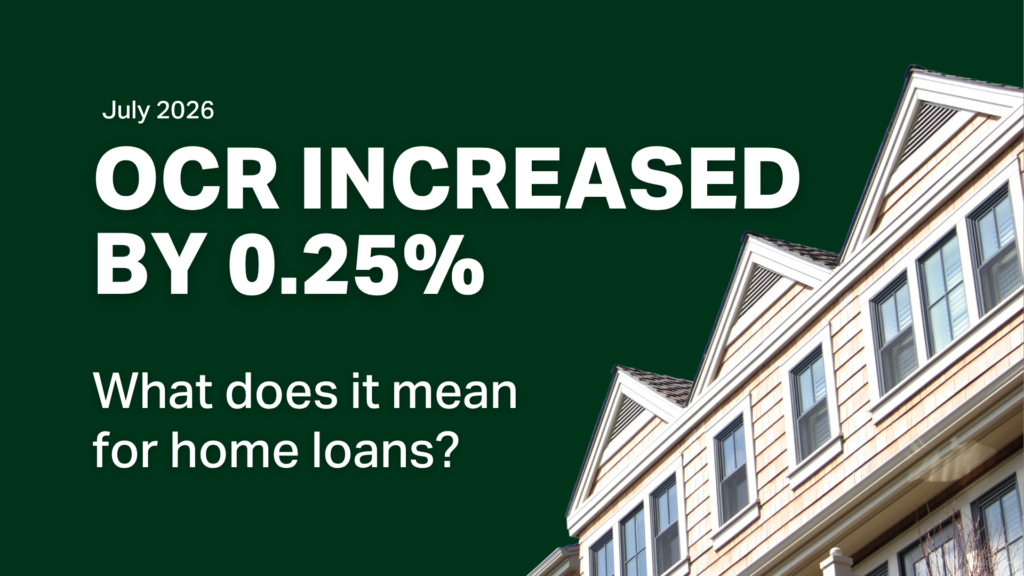
The OCR has increased by 25 basis points.
For anyone thinking about buying a home, those words probably do not sound particularly encouraging.
Higher OCR. Higher interest rates. More expensive mortgages.
Surely that means it is better to wait?
Maybe. But not necessarily.
Because while the latest OCR increase does put some upward pressure on borrowing costs, it is only one part of a much bigger picture.
Right now, buyers have something they have not always had in Auckland:
Choice. Time. And negotiating power.
House prices remain below their previous peaks. There are plenty of properties available. Competition is relatively subdued. And first-home buyers continue to make up a significant share of property purchases.
The question is not whether house prices are suddenly about to take off.
Nobody knows that.
The better question is: Could today’s buyer-friendly conditions change as confidence in the economy begins to return?
That is where things get interesting.
First, What Actually Happened With The OCR?
The Reserve Bank has increased the Official Cash Rate by 25 basis points to 2.50%.
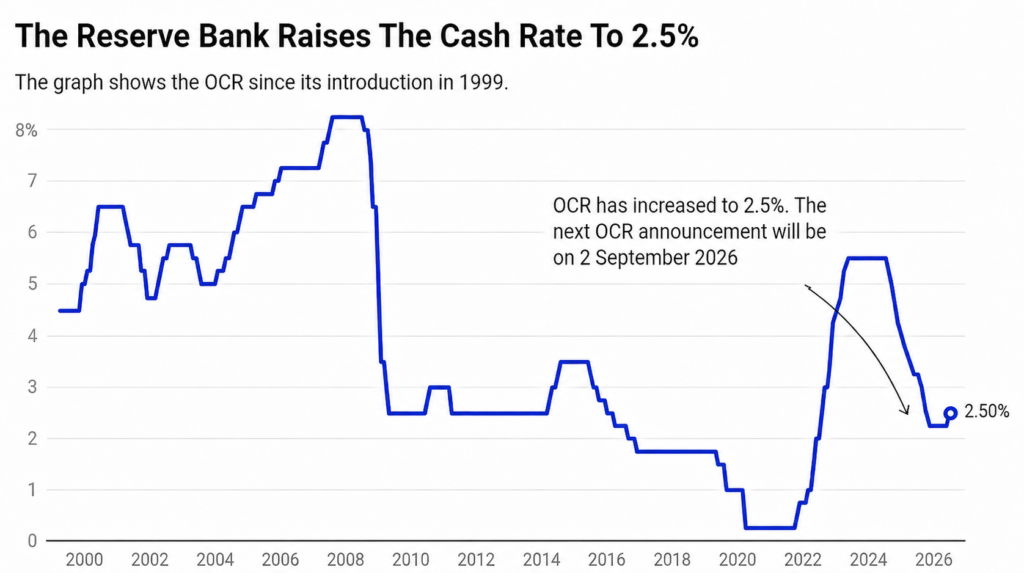
The OCR is one of the main tools it uses to influence inflation, interest rates and activity across the economy.
When the economy is weak, the OCR can be lowered to reduce borrowing costs and encourage spending and investment.
When inflation becomes more of a concern, the Reserve Bank can start lifting it again.
That is the main reason behind the latest move.
The Reserve Bank is trying to bring inflation back under control.
At the same time, it also expects the economic recovery to resume, which means New Zealand may gradually need less support from very low interest rates.
That does not mean the economy is suddenly booming.
It is not.
Think of it more like taking your foot slightly off the accelerator.
We are not travelling at full speed.
But the Reserve Bank believes we may not need quite as much help to keep moving.
Does This Mean Mortgage Rates Are About To Shoot Up?
For most borrowers, the immediate effect may be less dramatic than the headlines suggest.
Floating mortgage rates tend to respond more directly to changes in the OCR.
Fixed mortgage rates are different.
They are influenced heavily by wholesale interest rates and financial markets, which move based on what investors think the Reserve Bank will do next.
Because an OCR increase had already been widely expected, fixed mortgage rates had started rising before the announcement.
In other words, the market had seen this coming.
That does not mean mortgage rates cannot rise further.
They can.
But it does mean a 0.25% OCR increase does not automatically mean every fixed mortgage rate jumps another 0.25% overnight.
For buyers, the bigger question is no longer simply: “Will interest rates move?”
It is: “What happens to confidence, buyer activity and the property market from here?”
So, What Is Actually Happening In The Auckland Property Market?
At the moment, conditions remain relatively favourable for buyers.
There are plenty of homes available.
Price growth is subdued.
Buyers generally have more time to make decisions.
And in many situations, there is more room to negotiate than there would be in a hotter market.
That matters.
Anyone who remembers previous Auckland property cycles will know how quickly the experience of buying can change once confidence returns.
Open homes get busier.
More buyers become active.
Properties start attracting multiple offers.
And buyers who once had time to think suddenly find themselves competing.
We are not saying that is happening tomorrow.
We are saying that, for people who are genuinely in a position to buy, today’s conditions are unusually favourable.
That is worth paying attention to.
Does An Economic Recovery Mean House Prices Will Rise?
Not automatically.
This is where we need to be honest.
House prices do not move because of one thing alone.
They are influenced by interest rates, employment, wages, migration, lending conditions, investor activity, buyer confidence and the number of properties available for sale.
A stronger economy can support the property market.
When people feel more secure about their jobs and finances, they are generally more willing to make big decisions such as buying a home.
That can bring more buyers back into the market.
More buyers can mean more competition.
And stronger competition can eventually support property values.
But there is another side to it.
Higher interest rates can reduce borrowing capacity and make mortgages more expensive.
There are also more properties available for sale than during some previous market upswings, and stock levels remain high.
So no, an improving economy does not mean house prices are about to surge.
A fresh property boom is far from guaranteed.
But that also does not mean today’s market conditions will stay exactly as they are forever.
The Opportunity May Not Be “Buy Before Prices Boom”
That is too simplistic.
The real opportunity could be: Buy while buyers still have the upper hand.
There is an important difference.
- Right now, many buyers can:
- Take their time.
- Compare more properties.
- Ask more questions.
- Negotiate.
- Walk away if a home is not right.
Those things become harder when more buyers are competing for the same properties.
Even without a major rise in house prices, a shift in buyer activity can change the market.
A property might receive several offers instead of one.
A developer may have less reason to negotiate.
Buyers may need to make decisions faster.
The balance of power can begin to shift.
That is one of the risks of waiting.
Not necessarily that house prices suddenly jump 20%.
But that the market becomes less favourable to buyers than it is today.
Of course, waiting could still work in your favour.
Prices could soften further.
You could save a larger deposit.
Your income or financial position could improve.
The trade-off is that today’s level of choice and negotiating power may not still be there when you are ready.
First-Home Buyers Are Making The Most Of This Market
First-home buyers continue to be one of the strongest groups in the market.
And it is easy to see why.
Prices remain below previous peaks.
There is more choice.
Competition is lower than during the boom years.
And affordability in Auckland has improved compared with recent years.
That does not mean buying a home is suddenly easy.
Saving a deposit is still difficult.
Mortgage repayments still need to be carefully considered.
And nobody should stretch themselves beyond what they can realistically afford.
But for buyers who are financially ready, the current market offers something that was often missing during previous Auckland property cycles: Breathing room.
Why Waiting For Certainty Can Be Risky
People naturally want certainty before making a big decision.
They want to know:
- Will interest rates fall?
- Will house prices fall further?
- Will the economy improve?
- Is this the bottom of the market?
The problem is that property markets rarely send out an announcement saying:
“Congratulations. Today is officially the perfect time to buy.”
By the time the economy feels stronger, the outlook is clearer and everyone feels more confident, other buyers often feel exactly the same way.
That is when competition can start returning.
This does not mean you should rush.
It does not mean buying any property because you are afraid of missing out.
And it does not mean house prices are guaranteed to rise.
It simply means that waiting for complete certainty can come with a trade-off.
Sometimes the best buying conditions appear before everything feels comfortable.
So, Should You Buy Now?
That depends entirely on your circumstances.
- Can you comfortably afford the repayments?
- Do you have stable income?
- Have you spoken to a mortgage adviser or lender?
- Does the property suit your needs for the next few years?
If the answer to those questions is yes, then the current market is worth taking seriously.
Because while nobody knows exactly where house prices or interest rates will go next, we do know what buyers have today:
More choice.
Less competition.
Greater negotiating power.
And more time to make a considered decision.
The OCR increase is not a reason to panic.
It is also not proof that house prices are about to take off.
It is simply another sign that New Zealand may be moving into a different stage of the economic cycle.
And if confidence gradually returns, today’s buyer-friendly conditions may not last forever.
The opportunity is not to rush before prices boom. It is to act while buyers still have the upper hand.


